Academic, Professional, Technical, Trade, Research Books & Journals
americanpress@flash.net • 617-247-0022 • 75 State Street #100 • Boston, MA 02109
Research in Physical Education, Exercise Science and Sport
by CHARLES F. CICCIARELLA
3rd edition, 353 pgs,
ISBN 978-0-89641-514-0
$40.95 (includes shipping)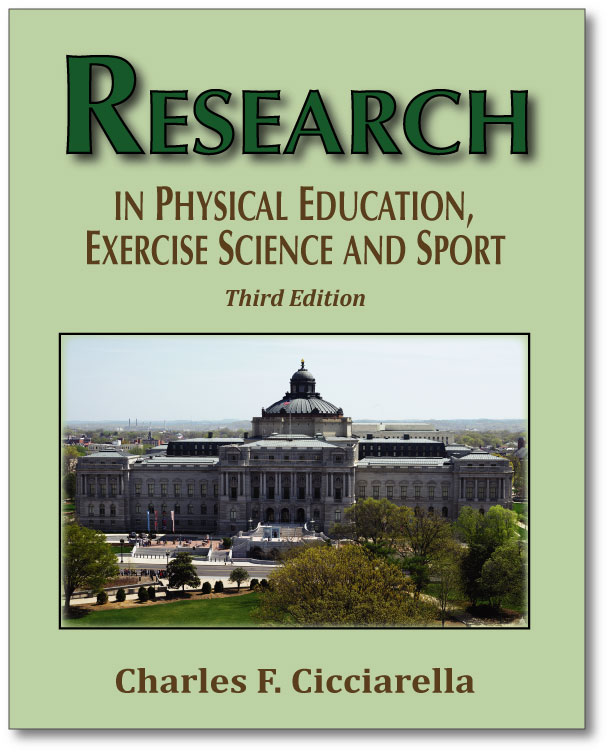
This book is designed for use as a text in academic programs preparing students either for professional practice in exercise science, physical education, sport management, coaching, and related professions or for subsequent advanced graduate work. Portions of this book may also find use as a reference by those occasionally engaging in research or as a text in programs requiring a baccalaureate thesis or other major exposure to research/inquiry concepts.
This book is distinguishable from other research methods texts in several important ways. First, great care has been taken to produce a text that is clear and concise, particularly in discussions of topics students frequently find quite difficult. Second, complex topics are supported by examples, illustrations, metaphors, and similar devices based on experiences that should be already familiar to most students. Many illustrations of statistical tools and concepts, for example, use data that might reasonably be generated within the world of sport. Third, this book defines research and scholarly inquiry quite broadly, thus recognizing the interdisciplinary, or perhaps more properly multidisciplinary, nature of our field. Along these lines, the first chapter discusses the wide variety of projects that may be classified as research. Fourth, an entire chapter is devoted to ethical conduct in research, including the more subtle issues involving conflicts of interest, misuse of research, and the risks faced by researchers willing to stand up for unpopular truths, as well as more obvious issues such as human and animal rights and scientific misconduct. Finally, significant effort has been made to take advantage of the widespread availability of computer technology for the teaching of research. In addition to coverage of electronic database searching and the Internet, for example, the statistical tables generally provided in the appendices of similar texts have been replaced by computer programs, available on disk to instructors, capable of performing the necessary computations directly. Rather than look up the significance of an F value, for example, the student can now compute areas under the F curves (and, thereby, probabilities of occurrence) directly. All graphs and tables in this book were produced using software commonly available to students. Although this results in somewhat lower quality than could otherwise be produced, this method was employed in order to provide more precise examples of typical computer-generated graphics.
Chapters 1 through 3 provide a context for research by introducing the student to scholarly inquiry and a variety of its forms, the role of the research requirement in academia, and the purpose and structure of research reports. Chapters 4 and 5 cover the researcher’s basic tools: the research library and concepts and issues of measurement. Chapters 6 through 10 discuss the research designs and methodologies associated with descriptive, experimental, historical, and exploratory and qualitative studies. Tools for data presentation and analysis are presented in Chapters 12 through 15. Chapter 16 deals with a wide range of ethical issues faced by the producer and consumer of research. Appendix A is written in the form of an additional chapter and may be used as a refresher by students whose background in mathematics is limited or not recent. Appendix B provides several sample documents the student may find useful, and Appendix C provides several useful MathCAD programs that take the place of statistical tables commonly found in texts of research methods or statistics.
CONTENTS
Chapter 1: THE PRACTICE OF RESEARCH
A Researcher’s Attitude
The Risk of Success
The Research Environment
The Method of Science
Research Projects in Academia
Redefining Scholarly Inquiry
The Research Project and Academic Documentation Requirements
Research Producers and Consumers
Types of Research Studies
Terms
Exercises
Additional Resources with AnnotationChapter 2: COMPLETING THE ACADEMIC RESEARCH REQUIREMENT
Target Dates and Deadlines
Finding a Topic
Selecting an Advisor and Advisory Committee
The Research Proposal
The Problem Hearing
Handling Data
Technical Assistance
The Oral Presentation
Final Matters
Terms
ExercisesChapter 3: THE RESEARCH REPORT
Preliminary Pages and Appended Materials
The Main Body of the Report
Tense in Research Writing
Avoidance of Sexist and Offensive Language
Style and Manuscript Preparation
Publishing the Results
Terms
Exercises
Additional Resources with AnnotationChapter 4: LIBRARIES AND RELATED RESOURCES
What is a Library?
Library-Like Resources
A Library Research Plan
Note Taking
Critical Reviewing
Copy Machines
Finding Things: Library Resources
Periodical Indexes
Other Indexes
Computerized Indexes
On-Line Indexes
Interlibrary Loan and Visiting Scholar Services
Microform Resources
Internet Resources
Major Reference Tools
Terms
Additional Resources with Annotation
ExercisesChapter 5: MEASURING THINGS
Definition
Error
The International System of Units
Compound and Derived Units of Measure
Conversion of Units of Measure
Measurement Instruments
Measurement Protocols
Precision
Validity
Reliability
Efficiency
Objectivity and Subjectivity
Variables and Scales of Measurement
Use of Significant Digits
Measuring the Hard to Measure
Terms
Exercises
Additional Resources with AnnotationChapter 6: MATTERS OF DESIGN
Threats to Validity of Research
Threats to Internal Validity
Threats to External Validity
Methods of Inquiry and Scientific Rigor
Types of Variables in Research
Research Pitfalls
Pilot Studies and Rehearsals
Terms
Exercises
Additional Resources with AnnotationChapter 7: DESCRIPTIVE RESEARCH METHODS
Populations and Samples
Methods for Sampling
Sample Size
Methods of Subject Contact
Maximizing the Rate of Subject Participation
Types of Survey Items
Survey Item Construction
The Delphi Method
Terms
Exercises
Additional Resources with AnnotationChapter 8: EXPERIMENTAL RESEARCH CONCEPT
Exploring and Experimenting
Where Do Hypotheses Come From?
It is Impossible to Prove a Negative
The Null Hypothesis and Its Alternatives
Pre-Experimental Designs
True Experimental Designs
Other Designs
Quasi-Experimental Designs
Meta-Analysis
Terms
Exercises
Additional Resources with AnnotationChapter 9: HISTORICAL RESEARCH METHODS
Scholarly Work in History
Historical Methods
Terms
Exercises
Additional Resources with AnnotationChapter 10: EXPLORING AND QUALITATIVE RESEARCH METHODS
The Focus Group Interview
The In-Depth Individual Interview
Systematic Observation
Participant and Non-Participant Observation
Context Analysis
Mathematical and Graphical Exploration
Terms
Exercises
Additional Resources with AnnotationChapter 11: DATA PRESENTATION
Bar Charts
Proportional Graphs
Scatter Diagrams
Line Graphs
Tree Diagrams
Flow Charts
Maps
Tabular Presentation of Data
Data Presentation Media
Exercises
References
Additional ResourcesChapter 12: A GALLERY OF GRAPHICS
Basic Graphs and Charts
More Bar Charts
More Histograms
More Pareto Graphs
More Scatter Diagrams
More Pie Charts
More Line Graphs
More MapsChapter 13: ELEMENTARY STATISTICS
Learning Statistics
Parametric and Non-parametric Statistics
Basic Descriptive Statistics
Variability
Interquartile Range and Quartile Deviation
Symmetry and Kurtosis
Transformations of Data
Transformations for Data Simplification
Terms
ExercisesChapter 14: RELATIONSHIPS AMONG VARIABLES
Multivariate Data
Association of Bivariate Data
Correlation Does Not Imply Causation
Correlation Statistics
Pearson’s Product-Moment Correlation
Spearman’s rho Correlation
Kendall’s tau Correlation
Kendall’s Coefficient of Concordance
Other Linear Correlation Statistics
Biserial and Point Biserial Correlation
Phi Correlation
Tetrachoric Correlation
Is an Association Real?
The Variance Interpretation of Correlation: Is an Association Meaningful?
Comparing and Combining Correlation Coefficients
Non-Linear Associations
The Regression Line
The R.M.S. Error for a Regression Line
Plotting Residuals
Partial and Multiple Correlation and Multiple Regression
Polynomial Regression
ExercisesChapter 15: MAKING GROUP COMPARISONS
Type I and Type II Error and Selection of the Alpha Level
Tests of Significance: Alternative Hypotheses
The z-Test
The t-Test
Analysis of Variance
One-Way Analysis of Variance
Two-Way Analysis of Variance
Fixed, Random, and Mixed Effects in ANOVA
Multiple Comparisons
Analysis of Covariance
Regression Analysis of Variance
Multivariate Analysis of Variance and Regression
Nonparametric Tests
Chi-Square
Chi-Square Test of Independence
Chi-Square Test for Goodness of Fit
The Validity of Chi-Square
Sign Tests
The Median Test (Sign Test for Independent Samples)
Sign Test for Correlated Samples
Sign Test for 3 or More Independent Samples
Rank Tests
Wilcoxon Rank Sum Test for Two Independent Samples of Ranks
Mann Whitney U Test for Two Independent Samples of Ranks
Wilcoxon Matched-Pairs Signed-Rank Test for Two Dependent Samples
Kruskal-Wallis Test for 3 or More Independent Samples of Ranks
Is a Difference Meaningful?
Tests Used in Meta-Analysis
Terms
Exercises
Additional Resources with AnnotationChapter 16: ETHICAL ISSUES IN RESEARCH
Plagiarism
Cheating
Copyright Infringement
Rights o Human and Animal Subjects
Scientific Ritual
Environmental Protection
Conflicts of Interest
Authorship and Publishing Standards
Terms
Exercises
Additional Resources with AnnotationAppendix A
Quick Math Review
Probability and Randomness
Permutations and Combinations
The Normal Curve
Properties of the Normal Curve
Types of Numbers
Mathematical and Logical Operations
Rounding and Truncation
Order of Operations
Scientific Notation
Terms
Exercises
Additional Resources with AnnotationAppendix B—Sample Letter and Forms
B.1 Sample Cover Letter for a Survey
B.2 Sample Human Subjects Review Form
B.3 Sample Informed Consent Statement
B.4 Sample Data Form for a Two-Condition Study
B.5 Sample Data Form for a Two-Group Study
B.6 Sample Data Form for a Two-Measure StudyAppendix C—MathCAD Programs
C.1 The Normal Curve
C.2 Area under the t-Curve and the t-Test
C.3 The F Distribution and F Test
C.4 Chi-square Distribution and Test
C.5 MathCAD Program for the z Transformation of the Correlation Coefficient
C.6 MathCAD Program for Random Number Generation
C.7 MathCAD Program for Calculating Roots and Powers
C.8 MathCAD Program for Computation of Combinations and Permutations DCD and InternetAppendices
ADDITIONAL RESOURCES
The following materials are available from the author.
- Color illustration files in jpg format.
- Data files in SPSS format, for data analysis practice using SPSS.
- Excel version of SPSS files described above, for data analysis practice using Excel.
To obtain them, simply send a request to the author, at Information@Charles Cicciarella
ABOUT THE AUTHOR ...
Charles Cicciarella is an associate professor of Health and Physical Education at Louisiana Tech University in Ruston, Louisiana. His primary areas of expertise include research methods and statistics, applied computing, aquatics, health and speleology. He received his Ed.D. in Human Movement from Boston University, his M.S. in Physical Education from Northeastern University and his A.B. in Biology also from Northeastern University. Dr. Cicciarella holds an endowed professorship, known as the "Melvin McCann Professor of Education."